For Iranian immigrants, many whose lives are shaped by exile, revolution and political upheaval, rooting for Team Melli has never been straightforward.
LOS ANGELES — Fans snuck them into the stadium. Demonstrators waved them outside the security gates. And at watch parties around the city, they appeared whenever the “home” team scored.
Get unlimited access to ad-free articles and exclusive content.
The lion-and-sun flag, associated with Iran before the 1979 Islamic Revolution, was seemingly everywhere across “Tehrangeles” on Monday as Iran opened its World Cup campaign against New Zealand.
But its meaning varied depending on who carried it.
Some told NBC News the flag symbolized solidarity with the Iranian people, who many feel have been isolated by conflict and political turmoil. Others said it represented opposition to Team Melli, Iran’s national soccer team, which they view as an extension of the clerical regime governing the Islamic Republic.
The competing interpretations reflect a question that has long weighed on the Iranian diaspora: Can pride in their country coexist with opposition to its government?
“I think at the moment people are so confused, people are so angry … and they don’t know whether they support our team or not,” said Helen Kohandel, who draped one of the flags over her shoulders as she prepared to enter the stadium on Monday, defying a ban on the flag from FIFA.
“Because after all, we know that they need to be supported by the regime, otherwise they can’t play.”
The thrill of the World Cup for this soccer-mad country and its diaspora comes at a hugely fraught time for Iranians both inside and outside of the country.
Thousands were killed during a brutal government crackdown earlier this year on anti-government unrest that had been sparked in part by soaring inflation.
Then, in late February, the U.S. and Israel launched a war that consumed the Middle East and was felt from Tehran to ‘Tehrangeles’ and beyond. On Sunday, not long before Team Melli landed on U.S. soil, President Donald Trump announced the two sides had agreed a deal to end fighting and reopen the Strait of Hormuz.
The news, however, came too late to benefit the team, which had already navigated several hurdles including visa issues and a last-minute move of its training camp from the U.S. to Tijuana, Mexico.
By gametime, Iran had been met with both jeers — as the national anthem played — and thunderous cheers — when Team Melli scored in the 2-2 tie.
“There were many Iranians here,” Coach Amir Ghalenoei told reporters after the match. “They believed in different political affiliations, different beliefs, but they all wholeheartedly encouraged us and I think that’s a victory for all of us.”
Some demonstrators said they wished Team Melli would do more to stand up against the regime, with several protesters outside the stadium calling on FIFA to expel the team entirely.
“All of us are here for a protest against Islamic Republic,” said Kourosh Salman, as a 15-foot lion-and-sun flag flew over his head. “Let us challenge them.”
But others said it’s unrealistic to expect political action from the players, as they are at risk of being punished if they defy the government.
“Separating politics from sports has gotten increasingly difficult because I think sports has gotten political, and politicians have come for sports,” actor and activist Nazanin Nour said in a phone interview ahead of the game.
In March, the Iranian women’s soccer team were branded “traitors” on state television after they didn’t sing the national anthem ahead of a match in Australia. The country granted six of the players humanitarian visas, but five quickly withdrew their claims for asylum and the women then sang the anthem at their following games.
Key striker Sardar Azmoun was omitted from the men’s World Cup roster after Iranian media reported that he had been expelled from the national team for what was described as an act of disloyalty to the government.
Ahead of the tournament, taking place across the U.S., Canada and Mexico, FIFA outlawed the lion-and-sun flag at matches, saying it violated the organization’s code of conduct prohibiting “banners, flags, fliers, apparel and other paraphernalia that are of a political, offensive and/or discriminatory nature.”
Many Iranians at the match, eager to express their views publicly, ignored the policy. Nour was among them, proudly posing with a lion-and-sun flag from the stands.
“The regime has taken away so much from Iranians,” Nour said. “But I don’t believe that me going to the game to show my pride in being Iranian means I support every player, or everything they stand for … Our love of being Iranian surpasses everything else.”
Nour said she understands why members of the diaspora struggle with whether to support Team Melli. “Everyone’s decisions are informed by their pain and trauma,” she said.
Ultimately, however, she decided the regime doesn’t “own our culture or our joy. We do.”
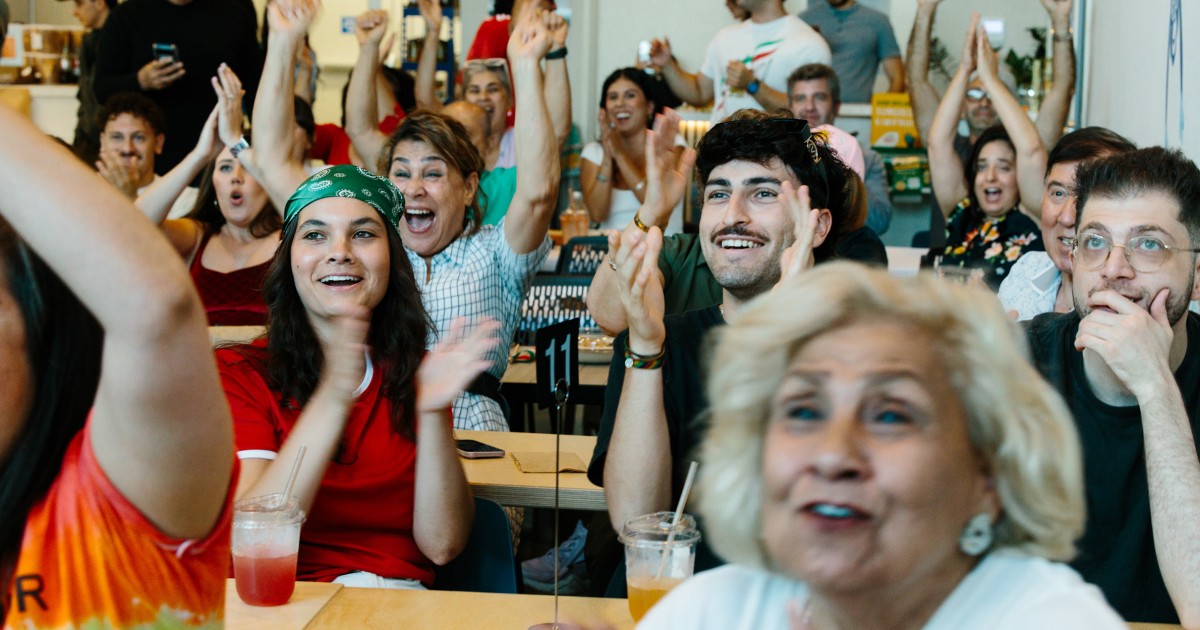
The roars each time Iran surged forward suggested she was far from alone. And across town, the mood was jubilant at Meymuni Cafe, where owner Shaheen Ferdowsi had organized a watch party centered around the community.
As patrons sipped on lavashak (traditional Persian fruit leather) smoothies and dug into Persian nachos, they erupted in applause and screams during Iran’s best moments of the game. For attendees, the focus was on soccer — and spending time with one another.
“I want to celebrate the people of Iran,” said Parvin, who requested that her last name be withheld due to concerns about potential political repercussions in her home country for speaking publicly on the issue. “The next generation, I just want them to be happy as they watch from home.”
Her sister, Parvaneh, who also requested her last name be withheld for the same reason, said she was watching the game out of “curiosity” — not excitement.
“I get chills seeing the flag,” she said, pointing to the official Islamic Republic of Iran flag on the TV screen as the game was kicking off.
Saba Hamedy is the trends and culture editor for NBC News.