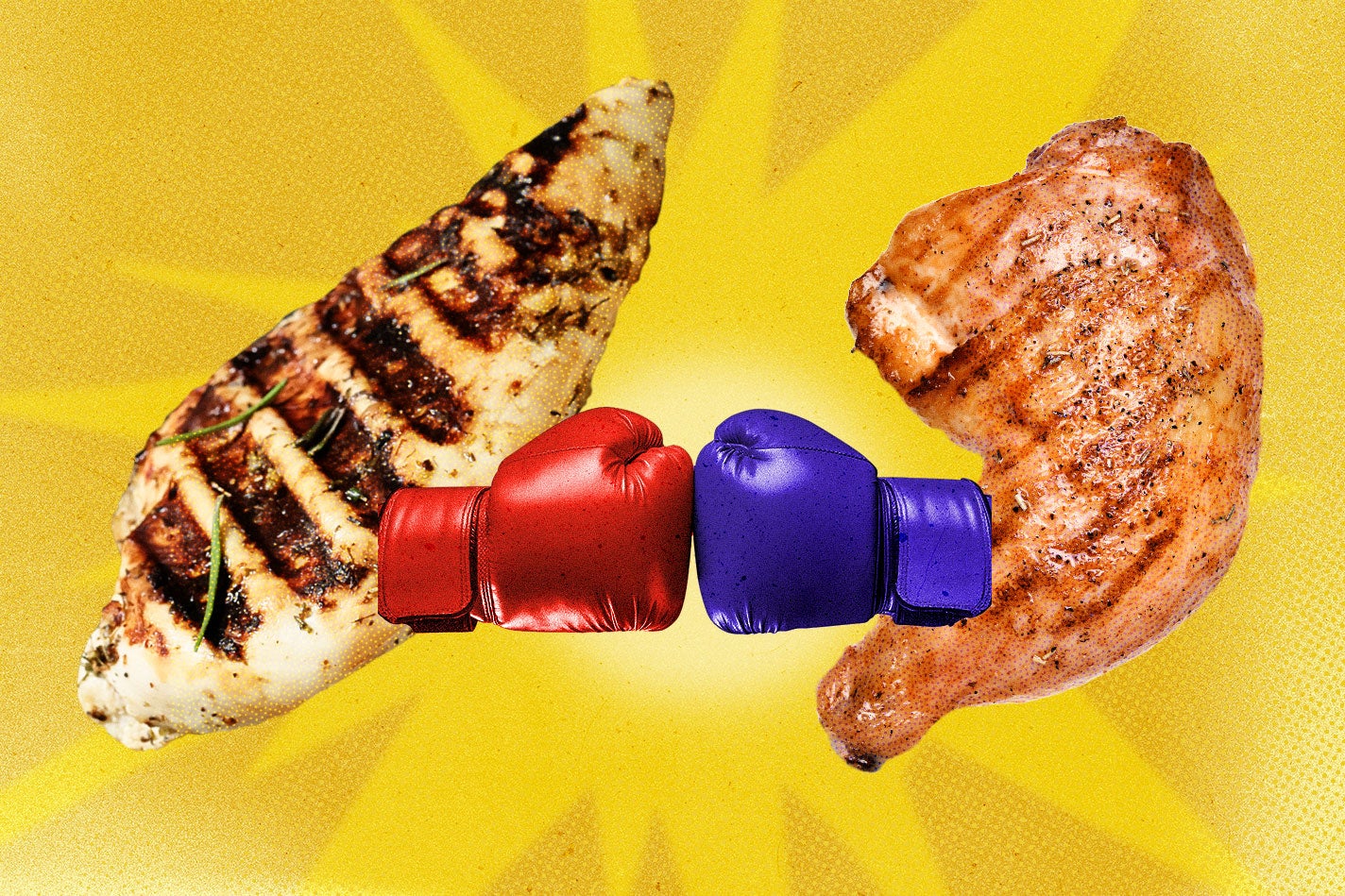
As we approach the celebration of America’s first 250 years this July, there’s going to be a lot of bald-eagle bluster and bravado. But don’t let it fool you: We’re a nation of chickens. In 2010, chicken finally overtook beef as the most consumed meat in the country. And more recently, we’ve become a nation of chicken thighs, which, of course we have—they’re easy to cook, flavorful, and affordable. From the inescapable over-one-billion-served chicken-thigh recipes online to the obvious propaganda pitting thighs against other, lesser cuts, if you know food, you know (or at least are supposed to know) that thighs are where it’s at.
But all this thigh-er love comes with a shadow. Whether it’s spoken aloud or left implicit, disdain for the chicken breast suffuses the air. It’s almost like we can’t express our appreciation for thighs without also condemning breasts in the same sentence. So, I ask: Is this fair? Has thigh supremacy gone too far? Surely there are some good chicken breasts out there, and good ways to cook them. What have we done with all the breasts?!
In 1991, writer Jim Harrison asked the opposite question in an Esquire essay, “What Have We Done With the Thighs?” In the piece, a beleaguered Harrison laments that he just can’t seem to find any chicken thighs: “In recent memory, I do not believe that I have entered a restaurant where thighs are allowed to stand alone proudly by themselves.” Harrison goes on to paint a pretty bland picture: a total, nationwide neglect of chicken thighs, and a near-religious devotion to lean, dry, relentlessly dull chicken breasts. “I think chicken breasts are the moral equivalent of a TV commercial,” he barbs. Chicken breasts seemed to embody something about the unadventurous, monotone food culture of the 1980s. “Is it because we are still Mummy’s children and crave the anonymous, tasteless breast?” Harrison wonders. He’s got a point about the childish palates of that era, but he’s only half right.
The truth is, for grocery shoppers and restaurant diners, thighs weren’t much of an option until relatively recently. Food production has changed drastically since the ’80s and ’90s. For one, we don’t ship the majority of our dark meat over to Russia anymore. But more importantly, advances in food automation meant that plants could debone chicken thighs in mass quantities, putting chicken thighs in our A&P refrigerator sections more dependably. As a result, since the late 2010s, chicken-thigh consumption has surged year over year. In April 2025, Sarah Zhang wrote about the end of chicken-breast dominance and the rise of the thigh for the Atlantic. “Home cooks have embraced the flavor and versatility of dark meat; fast-casual restaurants such as Chipotle and Sweetgreen have it all over their menus,” she writes. “America’s white-meat era may finally be ending.”
Part of the reason chicken thighs soared? Chefs of different cultures, here in America opening restaurants, chose the chicken thigh. A thigh is choice for the ever-popular Korean fried chicken, used often in Japanese cooking (karaage, teriyaki, etc.), and moreover was embraced by most chefs because it has two major things going for it: fat and flavor.
It’s worth remembering that during the glory days of breasts, fat was Public Enemy No. 1. The panic about cholesterol (born of a lot of misconceptions) was akin to the hysteria around Satan worship. So the breast—lean, virtuous, high in protein, low in fat—became the darling of diet fads, and was deemed a more responsible cut of meat to enjoy at a restaurant, too. Thighs? Well, that could kill you, partner. Today, fat isn’t demonized the way it once was (although chicken breasts remain the protein of choice for the uber-chiseled). Around the same time that we pumped the brakes on cholesterol panic and saturated fat-shaming, we embraced the delectable chicken thigh. And the more people ate chicken thighs, the more they realized that they weren’t just delicious, but downright hedonistic.
To wit: “Chicken thighs are in every conceivable way superior to breast, because unlike those bland lobes, thighs work for the money nonstop,” says a horned-up Alton Brown in his YouTube series, Alton Brown Cooks Food. “Therefore, their musculature is aerobic in nature, so it’s darker in color. And those muscles are sturdily connected to bone and joint, and much of that tissue can break down during cooking, becoming a lip-smacking juiciness the breasts can’t even dream about.”
Brown’s sexually charged diatribe is largely true: Chicken thighs do have more flavor. While breasts contain little fat and minimal connective tissue, thighs are biologically coded to taste better with their higher fat content. And that fat, when cooked slowly on low heat, also produces liquid gold: schmaltz. Slowly render skin-on chicken thighs in a cold pan, and you’ll be rewarded with a deeply delicious and salacious lubricant. It’s why you don’t need any oil or butter whatsoever to cook chicken thighs—they cook in their own fat.
Is there anything a breast can do that a thigh can’t? “Yeah, it can dry the fuck out,” says Mark Kurlyandchik, a former restaurant critic at the Detroit Free Press. And this seems to be the consensus among writers, chefs, and people with any sort of thriving food knowledge—white meat sucks; dark meat is where it’s at.
But is it possible that we’re getting too swept up in the dark-meat craze? With a bit of effort, I was able to find a chef or two who knows exactly how to make the breast shine. “You need to brine it and cook it to the right temp,” says Argentinian chef Javier Bardauil. “It’s a lot of work.” Brining, the process of loosening the protein strings through a saltwater bath, makes meat moist, and if aromatic ingredients are included in said brine, more flavorful too. Bardauil tells me it’s crucial to cook chicken to exactly the right temperature: 165 degrees. “No more than that,” he says, while also hinting that if you’re at home, you might want to cook breast under that law-abiding temperature (considering that residual heat will always bring meat up a degree or two after it’s removed from flame). While thighs are genuinely idiot-proof—great for home cooks and novices—breasts require a bit more plotting. So, if anything, producing a tasty chicken breast speaks more to a cook’s ability than tossing off a tasty chicken thigh.
I’d be remiss if I didn’t add that the fastest and most beloved way to prepare a chicken breast is by pounding it with a meat mallet. Both classically trained chefs and the humblest of nonnas employ this aggro method. Not only does the gentle smashing effectively tenderize this lean cut of meat, but a chicken breast that’s pounded is also inherently juicier; that’s because the interior and the exterior are roughly the same size, meaning it cooks quickly and evenly. It’s why chicken cutlets are the fastest way to any Italian American’s red sauce–stained heart. If a chicken breast isn’t pounded, well, you’re just asking for trouble (that is, a dry, flavorless dining experience).
While Brown makes great points about thighs, I do disagree with him on one thing: He asserts that a chicken thigh is best for a Chicken Parmesan. No. The breast is clean, lean, and ready to be stacked with breading, oil, cheese, and whatever else you want to throw on there. Carmenta’s in Brooklyn does an excellent Chicken Parm sandwich on a sesame seed–studded roll. And while chicken thighs make great fried-chicken sandwiches, lean cutlets make excellent Italian heroes. Why? Because the sandwiches are stacked with condiments. Delis all across New York City, like Lioni Italian Heroes, Faicco’s, Defonte’s, and more, all serve souped-up stacks of thin chicken-cutlet sandwiches loaded with accoutrement fried eggplant, stretchy in-house mozzarella, giardiniera, prosciutto di Parma, pesto, and whatever else these Italian-sandwich doctors want to throw on there because a chicken breast can take it. A thigh already has built-in fat and flavor; topping it with the aforementioned condiments is just overkill. Breasts are for the innovators, the artists, the creators.
Take Mabel Gray, a New American restaurant in Detroit with plenty of national acclaim, which currently serves a breaded and pan-fried Green Circle chicken breast with duck-fat Dijonnaise, herb-and-anchovy salsa, charred lemon, and frisée. “We dry a bunch of fresh herbs in the dehydrator and turn them into an Italian breadcrumb to three-step bread the thinly pounded chicken,” says chef James Rigato. Oh, is that too much work? Were you expecting to skip down the street and one-pot your way to a good chicken breast? Get it together, thigh man: Breasts take skill, and that’s why they’re so good. The salsa, the duck-fat Dijonnaise, the lemon, the powerful homemade breadcrumbs—these are all necessary steps to take to ensure the chicken breast is worthy of Mabel Gray’s high standards. They all accentuate the divinity of the chicken’s white meat.
Look, overall, I’m glad that thighs have catapulted into the larger culinary consciousness. Thighs rock. But we need breasts, too; they’re the lean, clean counterpoint to their rich and fatty cousin. They produce tasty chicken cutlets, wonderful Italian sandos, fresh and clean salads, shredded meat for soups, and so much more. Rather than seeing white meat as inferior, think of it, like Rigato does, as an open landscape on which to build your own flavor community. It’s a blank canvas for style and creativity, and if you’re lacking those, well … there’s always the 63 chicken-thigh recipes listed on the Food Network’s website.