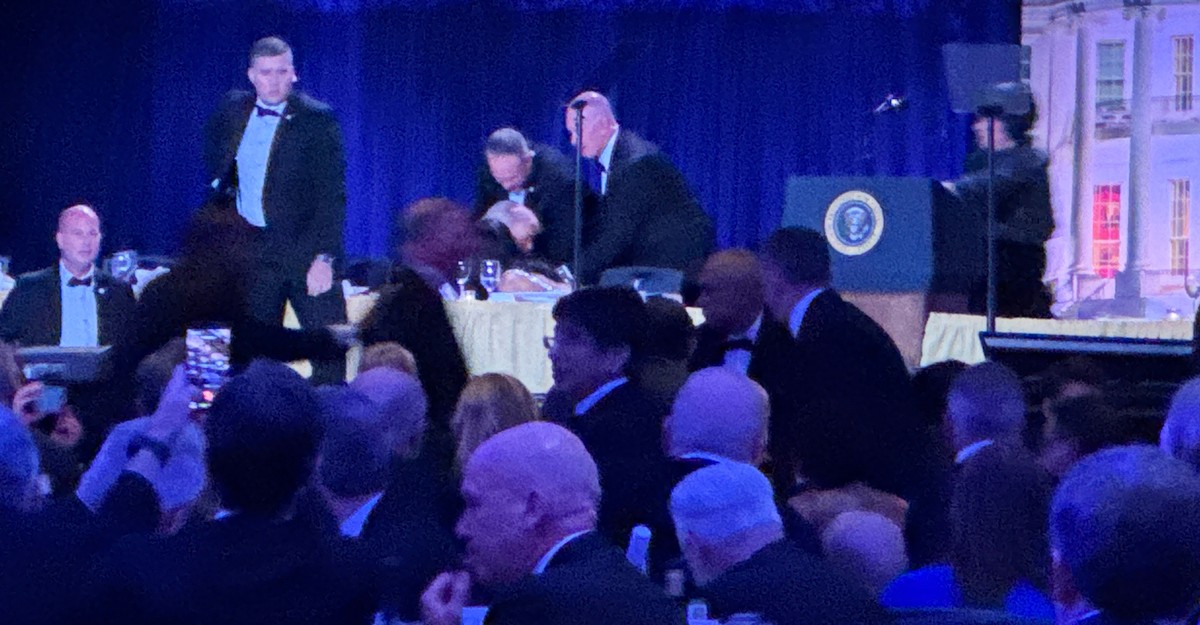
The president is safe after chaos at the Washington Hilton, and a suspect is reportedly in custody.
Updated at 1:29 a.m. ET on Sunday, April 26, 2026
We were under the table before we knew what was happening. One moment, a military band was parading out of the Washington Hilton’s cavernous ballroom; hundreds of government officials, diplomats, and journalists, including more than a dozen of us from The Atlantic, dressed in our best or borrowed black tie, had turned to our spring-pea and burrata salads.
The next moment, armed agents—maybe Secret Service, maybe police, maybe hotel guards; it was hard to tell from where we were huddled under a tablecloth—were pushing their way through mounds of people, climbing over chairs, rushing to the stage, where President Trump and First Lady Melania Trump had shortly before been seated.
Trays of plates and tableware fell to the floor with a crash. “Get down! Get down! Get under the table! ¡Abajo! ¡Abajo!” we heard security and waitstaff shout. There was at least one popping sound from the north end of the ballroom. People by the doors started to duck. Then plainclothes security rushed in.
One attendee sitting in the upper level of the ballroom right by the doors said that he heard five or six hollow shots close by, and—before diving under the table—saw a Secret Service agent with his gun drawn backing down toward the ballroom. Andrew Kolvet, a Turning Point USA spokesperson who was seated at a table near the dais, said he heard a “pop pop.”
Trump sat onstage for several seconds after the shots, watching people hit the floor before he was swarmed by his heavily armed security. President Ronald Reagan was shot and injured outside the same hotel in 1981. From then on, Washingtonians have known the sprawling building as the “Hinckley Hilton,” after the shooter John Hinckley Jr.
Secret Service rushed the president and Vice President J. D. Vance, seated several spots down the dais from Trump, out of the massive room. Cabinet members, lawmakers, and senior government officials were dotted throughout the crowd of more than 2,000 people. Those who attended the dinner, in addition to Trump and Vance, included House Speaker Mike Johnson, Secretary of State Marco Rubio, Treasury Secretary Scott Bessent, and Defense Secretary Pete Hegseth. (That made five out of the first six officials who would follow Trump in the line of succession; No. 3, Senator Chuck Grassley, doesn’t appear to have attended.)
Under the tables, we were piled on top of one another, squished together between table legs and high heels. Colleagues texted loved ones and tried to understand what was happening around them. Two men in suits dragged a woman in a green, sequined gown toward the door, each pulling an arm. As guests crouched down for safety, security agents hustled senior officials out of the ballroom, at least a couple of whom appeared to have been lightly injured amid the frenzy.
Attendees had passed through security gates before entering the ballroom. But that screening site was deep within the hotel and was relatively cursory in its execution. Overall, the security seemed lighter than at an airport. The priority appeared to be moving guests quickly through the process and on to the dinner.
When we emerged from under our tables, we and other guests asked one another what had happened. Journalists, lawmakers, and various officials all looked dazed; many panned the room with their cellphone cameras. At 8:55 p.m., about 15 minutes after the initial panic, hotel staff appeared and ordered all attendees to depart, waving their hands and shouting, “Let’s go! Go!”
As the press was escorted out, Kash Patel was in a basement hallway, on his phone and surrounded by a small security detail. Erika Kirk was standing near him, visibly emotional. Soon after, the Secret Service said that a shooting had occurred near a security-screening station, in a lower lobby outside the ballroom. (Footage released later showed the suspect, who police said was a guest at the hotel, sprinting through a detector as agents scrambled to apprehend him.) The suspect was in custody, the agency said in a statement. Trump, in a Truth Social post, said that he, the first lady, and Cabinet members were “in perfect condition” and would reschedule the dinner within 30 days.
Outside, in the chilly April evening, helicopters circled; ambulances with their lights flashing idled nearby. Reporters scrambled to reach the White House for a hastily scheduled presidential press conference. Some took scooters. Others hailed Ubers. Men in tuxedos and women in ballgowns arrived gasping, passed through security, and raced to where Trump stood behind a podium surrounded by the most senior members of his administration. Like him, they were in black tie. The first lady made a rare press-briefing-room appearance.
Trump had initially mistaken the sounds in the ballroom for a dropped serving tray, he recounted. And after he was escorted out, he said that he “fought like hell” to continue with the program. But his security personnel convinced him that it wasn’t safe, and his staff told him that his jokes might not land in the aftermath of the shooting.
Trump lavished praise on the Secret Service, saying he had spoken with one agent who was shot but survived because of a bulletproof vest. More unusual, the president also commended the roomful of reporters who covered the event. (He had been attending his first White House Correspondents’ Association dinner as president, having skipped previous years.) His plan, he said, had been to be rough with the press tonight, but he said he might not be able to be so rough at the do-over.
Trump described the Hilton as “not a particularly secure building,” then pivoted to make the case that the White House ballroom that he wants to build would be safer. When asked if he believed he was the target, Trump responded, “I guess,” but said that he didn’t know if the suspect, whom he called a “sick person,” was politically motivated. He then conjectured that would-be assassins seek out high achievers. “I must tell you, the most impactful people,” he said, “are the ones they go after,” and added: “I hate to say I’m honored by that, but I’ve done a lot.” Having experienced two previous assassination attempts, he said that he considers being president the most dangerous profession, asserting that presidential death rates far exceed those of bull riders or race-car drivers.
The area around the Hilton, in the meantime, remained sealed off by a wide police cordon, snarling traffic for blocks in downtown Washington, as hundreds of journalists filled nearby bars and sidewalks, phones in hand, to read a breaking-news story that had just happened to them.