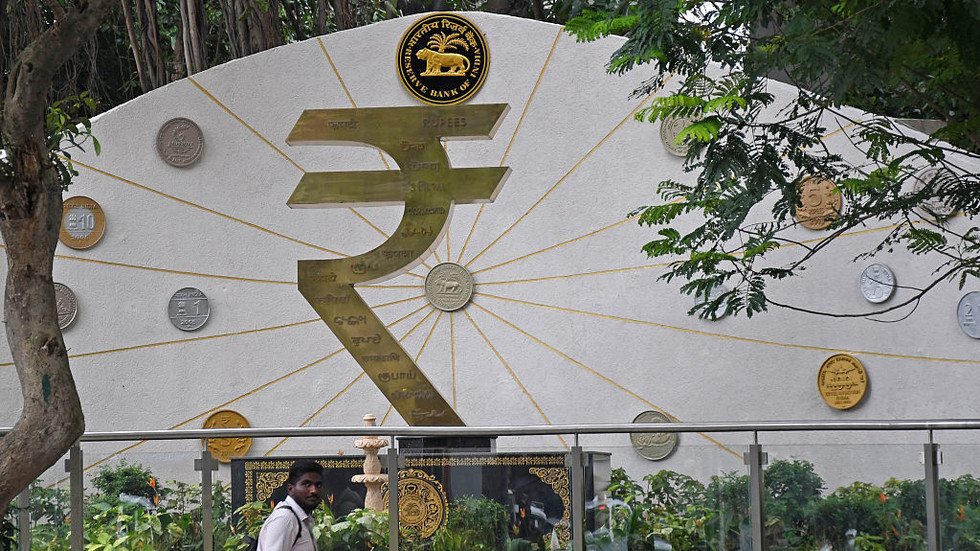
India’s central bank has warned of rising inflation risks as part of the fallout from the Middle East conflict.
The Reserve Bank of India (RBI) cautioned in its latest assessment that “upside risks have increased” on the inflation front.
“Though inflation remains contained within the tolerance band, upside risks have increased, driven by supply-side disruptions, including weather-related uncertainties,” the bank said in a bulletin on Thursday.
The RBI is taking a cautious approach but does not rule out the risk of inflation if the war persists, a top aide told the Economic Times.
Deputy Governor Poonam Gupta told the newspaper that the central bank’s assumption is that the conflict will be resolved in a few months, with “supply chains being restored subsequently and demand-supply normalizing thereafter.”
There is no evidence now of “second-round effects on inflation expectations,” she said, citing this as the reason the central bank “decided to watch and wait.”
The exact impact on the energy price would depend on the “duration of the West Asia conflict and how quickly normalcy returns to energy markets post conflict,” Gupta added.
Efficient coordination between monetary and fiscal policies has resulted in better management of inflation, she said.
The probability of El-Nino is unlikely to have a significant impact on agriculture, which has become more resilient to shocks, she noted.
Her comments come amid concerns that the Indian economy is expected to face inflationary pressure from rising petroleum product prices, following state elections.
On Thursday, HSBC downgraded India to underweight from neutral, a month after downgrading it from overweight.
The South Asian country’s economy is expected to grow 6.4% in FY27, slower than the 7.4% expansion estimated for FY26, due to the impact of the Middle East conflict, a UN report said on Tuesday.
The projections are in sync with the estimates of the Indian government and various multilateral agencies, the Mint newspaper reported.
The World Bank has projected India’s FY27 growth at 6.6% amid higher energy prices and supply chain disruptions. Despite this, New Delhi remains among the fastest-growing major economies, it said.